
ST.Stephen Colbert Raises an Uncomfortable Question: If Paramount Has $108 Billion, Why Was The Late Show Canceled?

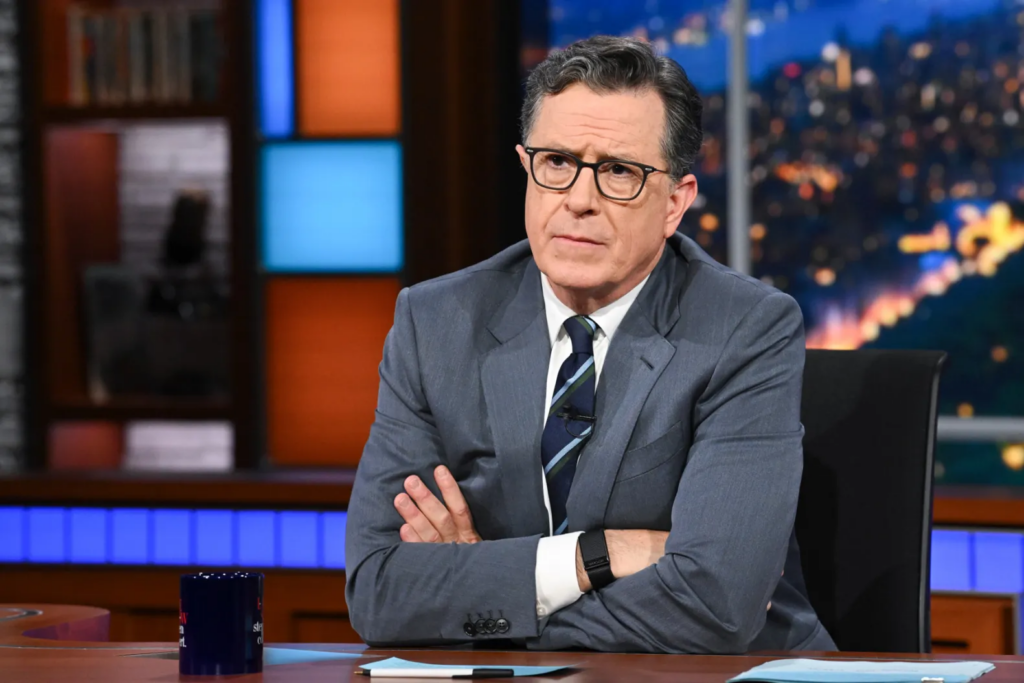
Stephen Colbert used his own stage this week to expose a contradiction that many in the entertainment industry have quietly noticed but few have openly questioned. If The Late Show with Stephen Colbert was canceled for “financial reasons,” why does its parent company suddenly have $108 billion available to pursue one of the largest media acquisitions in history?
During Tuesday night’s monologue, Colbert addressed reports that Paramount has launched a hostile takeover bid for Warner Bros. Discovery valued at more than $108 billion, entering a high-stakes bidding war with Netflix, which had already agreed to an $82.7 billion deal. The timing was impossible to ignore. Just months earlier, CBS announced that The Late Show would end in May 2026, citing annual losses of approximately $40 million.
Colbert did not plead for sympathy. Instead, he did what has defined his career: he used satire to reveal the logic gap. If Paramount can mobilize nine-figure billions for expansion, he suggested, it is difficult to argue that one of television’s most successful late-night franchises was simply “too expensive” to keep.

The reaction from the studio audience was immediate and telling. Cheers erupted, and chants of Colbert’s name filled the room. It was less a protest than a recognition: audiences understand when a business explanation does not fully align with the facts presented.
The Late Show is not a struggling program. It has consistently ranked as the most-watched late-night talk show in the United States, outperforming competitors in both total viewers and key demographics. That reality is what fueled speculation when CBS first announced the cancellation. Critics questioned whether financial losses were the sole reason—or merely the safest reason to cite publicly.
Those suspicions intensified as Paramount moved forward with its proposed merger with Skydance, a deal requiring government approval. Some observers suggested that reducing politically sharp programming could make the company a less controversial target during a sensitive regulatory process. No evidence has confirmed this theory, but the optics remain difficult to dismiss.
Colbert sharpened his commentary further by highlighting the composition of Paramount’s bid. Approximately $24 billion of the financing reportedly comes from Middle Eastern sovereign wealth funds tied to Saudi Arabia, Qatar, and Abu Dhabi. Colbert joked that such funding surely comes with “no strings attached,” before mock-previewing a fictional CBS sitcom titled Young Mohammed bin Sheldon. The line landed not because it was outrageous, but because it underscored a deeper concern about influence, power, and independence in modern media.
Previously, Colbert has taken a measured public stance on the show’s ending, acknowledging that television programs inevitably conclude. Yet he also noted something historically unusual: The Late Show may be the first number-one program in its category to be canceled outright. That distinction carries weight, especially in an era where underperforming shows are usually the ones removed.
What unfolded on Colbert’s stage was more than a late-night joke. It was a reminder of what political satire has traditionally been meant to do—question authority, expose contradictions, and force powerful institutions to justify their decisions. In a media landscape increasingly shaped by mergers, debt structures, and political calculation, those moments have become rarer.
Whether or not The Late Show could have been saved is ultimately beside the point. Colbert’s monologue accomplished something more enduring: it made the public ask why a company claiming financial restraint is simultaneously willing to wager $108 billion on corporate expansion.
