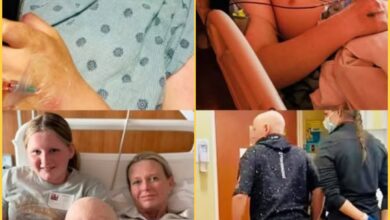
Meet Gracelynn — a little girl whose strength has rewritten every expectation.
At just nine months old, Gracelynn has already faced more than most people do in a lifetime. Her journey began long before she ever took her first breath.
At her 20-week anatomy scan, her parents were told something didn’t look right. What was meant to be a routine appointment quickly turned into fear and uncertainty when they were referred to a maternal-fetal medicine specialist due to abnormal findings. Two weeks later, at 22 weeks pregnant, they received news no parent is ever prepared for — Gracelynn had a congenital heart defect. The diagnosis was still unclear, but they were told she would need to be followed closely by a fetal cardiologist.

Despite countless appointments and scans, doctors were unable to fully understand what was wrong with her heart until she was born. On April 24, 2024, Gracelynn arrived full term — a beautiful baby girl welcomed into the world with so much love. But her fight began immediately. Shortly after birth, she was admitted to the NICU at the University of Iowa Children’s Hospital due to severe feeding intolerance. While there, she underwent numerous echocardiograms and EKGs, which finally revealed the truth: Gracelynn had Double Outlet Right Ventricle and a very large ventricular septal defect (VSD).
Her parents’ world changed overnight.
On September 17, 2024, at just five months old, Gracelynn underwent her first open-heart surgery to repair the VSD. The surgery was successful, but her journey was far from over. In November, a follow-up echocardiogram revealed devastating news — another hole in her heart had been missed.

In December 2024, Gracelynn underwent a detailed CT scan of her heart. Doctors even created a 3D-printed model of her heart to better understand the complexity of her condition. The newly discovered defect was in an extremely difficult and dangerous location — hidden behind heart muscle and dangerously close to her aortic valve.
On January 28, 2025, Gracelynn faced her second open-heart surgery. This time, the procedure required over three hours on the bypass machine as surgeons carefully repaired the defect, working millimeters away from her aortic valve. It was a long, terrifying day — but Gracelynn fought once again.
As if heart surgeries weren’t enough, Gracelynn also lives with a bilateral cleft lip and palate, creating additional challenges with feeding, breathing, and communication. Every bottle, every breath, and every milestone has required extra strength — and extra courage.

Yet through it all, Gracelynn continues to amaze everyone around her. She has endured two open-heart surgeries, countless hospital stays, and ongoing medical challenges — and she meets each day with resilience beyond her age. Her smile, her determination, and her quiet bravery remind everyone who meets her what true strength looks like.
Gracelynn is more than her diagnoses.
She is a fighter.
She is a miracle.
And she is living proof that even the smallest hearts can be incredibly powerful.
The Child We Waited For 10 Years, and the Fear of Losing Her Every Day
“We waited ten years for this child. And now, every single day, we live with the fear that he could be taken from us.”
For ten long years, Misha existed only in hope. His parents learned how to wait in silence. They learned how to smile at baby showers while swallowing their own grief. They learned how to pray without knowing if anyone was listening. Every year that passed without a child carved a deeper ache into their hearts, yet they never stopped believing that one day, somehow, their miracle would come.

When Misha was born, it felt as though the universe had finally answered them. He was perfect. Warm. Real. His mother remembers holding him for the first time, terrified to blink, afraid that if she did, the moment might disappear. His father watched in awe, overwhelmed by the fragile weight of the child they had waited nearly a decade to meet.
Misha learned to laugh. To run. To explore the world with the curiosity only a small child has. Their home filled with toys, bedtime stories, and the kind of ordinary happiness they once believed might never belong to them. They were finally a family.
Then came the fever. At first, it seemed harmless. A child’s illness. Something temporary. But the fever didn’t go away. Days turned into weeks. Weeks turned into months. His mother returned to doctors again and again, her instincts screaming that something was wrong.

“It happens,” they said.
“He’ll grow out of it.”
“Just wait.”
But a mother knows when waiting is dangerous. One evening, her husband looked at her and said quietly, “Get an ultrasound. Everything.” That decision changed their lives forever. She still remembers the doctor’s face—the hesitation, the silence, the way his eyes avoided hers. She remembers the screen. The word she never imagined would be spoken about her child. Tumor. Misha sat beside her, smiling, swinging his legs, unaware that his childhood had just been replaced by hospital rooms, needles, and fear. His mother held his hand and felt her world collapse.
What followed was a nightmare no parent is ever prepared for. Chemotherapy stripped his tiny body of strength.
Radiation stole his energy.
Surgeries came one after another.
Anesthesia became routine.
A bone marrow transplant pushed his body to its limits.
There were nights his parents stayed awake, listening to his breathing, terrified it might stop. Days when he was too weak to eat. Moments when hope felt impossibly far away.
And yet, it was Misha—the child—who became their strength. “Mom,” he would whisper, “everything will be fine.” A little boy comforting his parents while fighting for his life. Against all odds, Misha survived. Slowly, painfully, he recovered. He laughed again. He ran again. He dreamed of returning to kindergarten. His parents allowed themselves to believe that the worst was behind them—that their miracle had endured the storm.
For a while, life returned.
Then, quietly, the fear crept back in.

In September, test results began to change. Numbers shifted. Doctors grew cautious. By November, the words they dreaded most were spoken again. The tumor is growing back. Now, his parents watch Misha play, laugh, build towers, and dream—knowing that inside his small body, the disease is hiding once more. Every joyful moment is shadowed by fear. Every smile feels fragile. Doctors have been honest. After two relapses, Misha needs specialized treatment abroad to have a real chance at survival. That chance exists—but it comes at a cost his family cannot carry alone.
The amount required is 1,176,000 rubles. An impossible sum for a family that has already given everything—emotionally, physically, financially—to keep their child alive. They are not asking for comfort. They are not asking for sympathy. They are asking for time. Time for Misha to grow. Time to learn. Time to become the person he dreams of being.
Misha waited ten years to come into this world. He has fought through pain most adults could not endure. He deserves the chance to live. His parents stand once again at the edge of fear—not as fundraisers, but as a mother and father pleading for their child. “Please help us save our son,” they say. “Every donation, every share, every prayer brings us one step closer to keeping him with us.” This is not just a story about illness. It is a story about love that waited ten years to exist. About faith that refuses to break. About a child who deserves a future.
She Was Born Without Arms — The World Knows Her as ‘The Girl With Wings’
In a world that often measures ability by what a person has, there are rare stories that remind us how much stronger the human heart can be than any physical limitation. This is one of those stories. It belongs to Dejana Backo — a Serbian artist, motivational speaker, athlete, and now a devoted mother. Born without arms, Dejana has spent her life showing the world that strength is not defined by the body, but by the spirit.

From the moment Dejana was born, doctors delivered a verdict no family should ever have to hear. They told her parents that she would never live a normal life. They spoke of limitations, dependency, and hardship. But her parents refused to let those words become her destiny. Instead of raising her as a child defined by what she lacked, they raised her to believe in who she could become.
And she proved them right.

Growing up in Novi Sad, Serbia, Dejana learned early that her feet could become her hands. She painted with her toes, played with toys using her feet, and learned to write by carefully gripping a pencil between her toes, guiding it across the page with remarkable control. Every small achievement — feeding herself, opening doors, styling her hair — became a quiet act of defiance against a world that expected less from her.
By her teenage years, Dejana was no longer simply adapting to life — she was excelling at it. Her artwork, created entirely with her feet, began gaining attention across Europe. She painted landscapes, portraits, and emotional scenes filled with color and movement, each piece carrying a reflection of her resilience. “Art was my voice,” she once said. “It allowed me to show the world that I could create beauty in my own way.”

But her journey didn’t end with art.
Dejana also found her strength in sport, joining the world of para-taekwondo. Through discipline, focus, and determination, she trained relentlessly — and won. Medals followed. Titles followed. By her early twenties, she had become a national champion, a symbol of pride for Serbia, and a powerful advocate for people with disabilities around the world.

Still, despite her success, Dejana carried a deeply personal dream: to become a mother.
That dream grew closer when she met Marko Nezić, a fellow athlete and coach. Marko didn’t see her disability — he saw her courage, her humor, and her limitless determination. “She’s the strongest person I know,” he once said. “Being with her reminds me how much we all take for granted.”

Their relationship was built on partnership and respect. Life together was filled with art, training, laughter, and shared dreams. Then came the moment that changed everything: Dejana discovered she was pregnant.
“I was scared,” she later admitted. “Not because I didn’t want to be a mother, but because I wondered how I could do it without arms. How would I hold my baby? Feed her? Comfort her when she cried?”

Marko stood beside her through every fear. Together, they planned, adapted, and trusted one another. Dejana approached motherhood the same way she had approached every challenge in her life — with creativity, courage, and unwavering heart.
In late 2023, their daughter Lara was born — healthy, beautiful, and perfect. When Dejana first saw her, tears filled her eyes. Joy came instantly, followed by a quiet ache. “I wanted to hold her,” she recalled. “I wanted to pick her up on my own. And at first, I couldn’t.”

The early days were difficult. Marko handled much of the physical care, gently placing Lara in Dejana’s lap or beside her so they could bond. Dejana practiced endlessly, experimenting with posture, balance, and movement. In a TikTok video that later reached millions, she shared, “At first, I cried because I felt helpless. But then I remembered who I am. I’ve learned everything else in my own way. I knew I could learn this too.”

And she did.
Through patience and determination, Dejana taught herself how to care for Lara using her feet, shoulders, and incredible ingenuity. She learned how to lift her baby from the crib, change diapers, feed her, and hold her close. Videos of her gently cradling Lara — adjusting her with careful foot movements, eyes filled with love — touched hearts around the world.
Her motherhood became a powerful reminder that love is not measured by hands or arms, but by presence, patience, and devotion.

Millions have watched her journey unfold online. Not with pity, but admiration. Comments pour in daily:
“You redefine strength.”
“This is real love.”
“Supermom.”
Dejana responds with humility. “I’m not perfect,” she says. “Some days I’m exhausted. Some days I cry. But every time I see Lara smile, I know it’s worth everything.”
At home, life is a portrait of partnership. Marko calls Dejana his hero. Together, they’ve built a rhythm rooted in teamwork, laughter, and deep understanding. In one tender moment shared online, Dejana sits beside Lara’s crib, singing softly. With her toes, she gently touches her daughter’s tiny hand as Lara coos in response. “She doesn’t care that I don’t have arms,” Dejana says. “She just knows I’m her mama.”

Beyond motherhood, Dejana continues to inspire audiences worldwide. She speaks at schools and organizations, sharing her story and encouraging others to embrace their differences. “Disability is not the end,” she tells them. “It’s the beginning of a new way to live, a new way to love.”
Today, Dejana sits on the floor of her living room with Lara playing beside her. She reaches out with her foot to tickle her daughter’s chin, laughter filling the room. Marko watches from the doorway, smiling. It’s an ordinary moment — yet profoundly powerful.

Because this life — this family, this joy — was once something the world told her she could never have.
And yet here she stands: a mother, an artist, an athlete, and a living reminder that every “can’t” can become “I did.” When asked what she hopes people take from her story, Dejana’s answer is simple: “Love always finds a way.” And as Lara grows, safe in the embrace of a mother who doesn’t need arms to love her completely, the world continues to learn a timeless truth — the strongest embrace doesn’t always come from hands.

Sometimes, it comes from the soul.
Three Tiny Miracles: A Journey Through Premature Triplet Birth
Three Tiny Miracles: Nichara Holcombe’s Journey Through Premature Motherhood
For Nichara Holcombe, December 2024 began like any other month — until a routine prenatal appointment changed everything. What was meant to be a standard check-up became a moment that would redefine her life: she was expecting triplets. Naturally conceived. Unexpected. Life-altering.
“I’ll never forget the look on my husband’s face,” Nichara recalls. “Shock and joy all at once. I felt completely overwhelmed — but in awe.”

From that moment on, every plan shifted. Every expectation expanded. The Holcombes prepared not just for a baby, but for three tiny lives arriving together.
As her pregnancy progressed, Nichara’s care team grew more vigilant. By May, her doctor recommended transferring her care to Lucile Packard Children’s Hospital Stanford, knowing the medical complexities that accompany triplet pregnancies — particularly the high risk of prematurity. While singleton pregnancies typically reach full term at 39 to 40 weeks, multiples rarely extend beyond 34 weeks, requiring specialized maternal-fetal medicine and neonatal expertise.
That expertise soon proved essential. Doctors identified fetal growth restriction in Baby B — later named Za’Riah Nichole — a condition that can affect how well a baby grows in the womb. Early diagnosis allowed the care team to closely monitor Nichara and her babies, setting the stage for the best possible outcome.

At 32 weeks, in early June, Nichara arrived at Packard Children’s Hospital. Five days later, on a Saturday, her triplets made their entrance into the world — Ny’Lah, Za’Riah, and I’Sa Curry — born just minutes apart. “The delivery itself was surprisingly fast,” Nichara says. “Less than two hours. Everything happened so quickly.”
Their arrival marked the beginning of a new chapter — one written inside the Neonatal Intensive Care Unit (NICU).
For families of premature multiples, the NICU is both a lifeline and a test of endurance. The babies’ immature bodies needed support with breathing, feeding, and temperature regulation. Machines hummed constantly. Alarms became familiar. Yet amid the clinical intensity, compassion was everywhere.
“The nurses and doctors were like a second set of hands,” Nichara explains. “Especially when you’re learning how to care for three babies at once.”

Guided by the NICU team, Nichara embraced kangaroo care, holding each baby skin-to-skin. Those quiet moments — warm, steady, and intimate — helped regulate the babies’ heart rates and breathing, while strengthening the bond between mother and child. “It became part of our routine,” she says. “It grounded me.”
Though the journey wasn’t easy, progress came steadily. All three babies experienced gastroesophageal reflux, a common but manageable condition in premature infants that can affect feeding. According to Dr. Cody Arnold, neonatal-perinatal specialist at Stanford Medicine Children’s Health, the babies gradually tolerated feeds better and gained weight, allowing them to be discharged home on a specialized formula.

Their hospital stays lasted nearly two months, but each milestone — each ounce gained, each tube removed — was celebrated.
“Nichara’s dedication was remarkable,” says Jacqualine Johnson, clinical social worker at Stanford Medicine Children’s Health. “She learned each baby’s individual needs and stayed actively involved in their care. Her strength truly shaped their NICU journey.”
Today, Ny’Lah, Za’Riah, and I’Sa are home — thriving, growing, and meeting their developmental milestones. Looking back, Nichara reflects with gratitude and perspective.
“Trust yourself. Trust the medical team. And give yourself grace,” she advises other parents walking a similar path.

As we recognize Prematurity Awareness Month, Nichara’s story stands as a powerful reminder: high-risk pregnancies and premature births are not defined by fear alone. With expert care, resilience, and unwavering love, even the most delicate beginnings can lead to beautiful, hopeful outcomes.
Three babies. One mother. And a journey that turned uncertainty into triumph. 💙