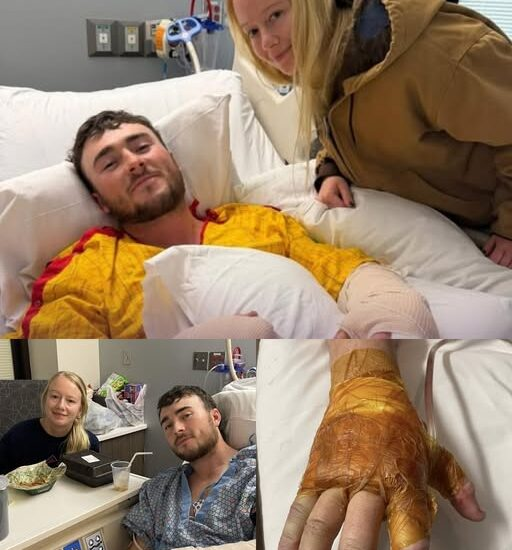
Latest ICU Update From LSU Health Shreveport: Small Signs, Big Meaning in Hunter’s Recovery
Inside the intensive care unit at LSU Health Shreveport, early Tuesday morning felt different.
Not dramatic.
Not celebratory.
But different enough that doctors and family members noticed.
After weeks of life-threatening complications following a 13,000-volt electrical injury and emergency vascular surgery, Hunter showed subtle — but meaningful — signs of stabilization.
And in critical care medicine, subtle can be everything.
A Quiet Shift in the ICU
According to family members, Hunter slept through most of the night — something that has been rare during this turbulent stretch of recovery. He woke briefly around 4 a.m.
That detail may seem small to outsiders. Inside an ICU, it’s significant.
Rest allows the body to regulate inflammation, stabilize blood pressure, and support tissue repair. For patients recovering from electrical trauma and vascular reconstruction, uninterrupted sleep can signal improved neurological stability and reduced systemic stress.
For the first time in days, there was a cautious sense that his body was not merely reacting — it might be recalibrating.
Medical staff later assisted Hunter into a wheelchair for a short period while performing careful dressing changes on his right hand.
It wasn’t a long session. It wasn’t a dramatic physical therapy milestone.
But it represented something crucial: tolerance.
His cardiovascular system handled the upright positioning. Circulation remained stable during wound care. Oxygen levels held steady.
In trauma recovery, tolerance to small stressors often signals underlying progress.
Why “Small” Improvements Matter After Electrical Injury
Electrical injuries are uniquely unpredictable.
Unlike traditional burns, high-voltage trauma travels through the body, damaging muscle fibers, blood vessels, and nerves beneath the skin. Surface wounds can appear stable while deep tissue continues evolving.
Hunter’s case has already demonstrated that volatility. A previously injured artery ruptured unexpectedly days after initial stabilization, requiring emergency surgical reconstruction.
Because of that history, physicians are watching every data point closely:
- Blood pressure trends
- Oxygen saturation levels
- Lactate values
- White blood cell count
- Tissue perfusion markers
- Wound response to treatment
In cases like this, stabilization doesn’t mean recovery is guaranteed. It means the body may finally be finding equilibrium after repeated shocks.
That possibility is why Tuesday morning felt different.
ICU vs. Step-Down: The Decision Ahead
Later today, physicians at LSU Health Shreveport are expected to determine where Hunter will spend the next 24 hours.
The options:
Remain in ICU:
If lab values fluctuate, circulation appears unstable, or infection risk increases, critical monitoring will continue in the intensive care unit.
Transfer to a Step-Down Unit:
If vital signs remain steady and wound response continues improving, doctors may consider transitioning him to a lower-acuity setting with continued observation.
The decision is not symbolic. It reflects measurable criteria.
ICU discharge requires:
- Sustained hemodynamic stability
- Controlled pain levels
- Acceptable lab trends
- No active surgical complications
- Manageable infection risk
Medical teams emphasize that step-down transfer does not mean “out of danger.” It simply signals reduced immediate risk.
Given Hunter’s history of sudden complications, caution remains high.
Monitoring the Wounds Hour by Hour
One of the most critical aspects of Hunter’s recovery involves tissue viability.
Electrical injuries can lead to delayed necrosis — meaning tissue that initially appears viable may deteriorate days later.
Doctors are evaluating:
- Skin coloration changes
- Temperature differences between limbs
- Capillary refill time
- Swelling progression
- Signs of compartment pressure
- Response to antibiotic therapy
The fact that medical staff were able to complete dressing changes with Hunter upright — without cardiovascular instability — is encouraging. It suggests circulation is currently sufficient to tolerate mild stress.
But physicians are not celebrating.
They know how quickly progress can reverse in high-voltage trauma cases.
The Emotional Weight of “Cautious Hope”
For Hunter’s family, this morning carried emotional complexity.
Hope was present.
But guarded.
After experiencing the shock of an unexpected arterial rupture and emergency surgery, optimism now comes layered with realism.
They’ve learned that improvement can shift quickly.
That lab numbers can swing.
That swelling can return.
That infection markers can spike without warning.
Yet this morning offered something they haven’t felt consistently in days: stillness.
No alarms escalating.
No urgent surgical consults.
No rapid response teams.
Just monitoring. Observation. Watching.
In a trauma ICU, quiet can be powerful.
What Happens Over the Next 24 Hours
Medical experts say the next phase will focus on three primary areas:
1. Vascular Stability
Ensuring the reconstructed artery continues functioning without clotting or leakage.
2. Infection Prevention
Electrical injuries create high infection risk due to deep tissue damage. Antibiotic therapy and lab monitoring remain central.
3. Organ Function Monitoring
Kidneys, heart rhythm, and lung function will continue under close observation, particularly after prior blood loss and surgical stress.
If all markers trend positively, Hunter could move closer to rehabilitation-focused care.
If instability emerges, the ICU remains ready.
Why This Morning Felt Different
There was no dramatic turning point.
No announcement.
No declaration of victory.
But sometimes progress in trauma recovery arrives quietly.
A full night of sleep.
A stable 4 a.m. wake-up.
Tolerating a wheelchair.
Steady labs through early rounds.
In cases like Hunter’s, these are not minor details.
They are indicators.
Signals that the body may finally be shifting from crisis response to controlled healing.
The Reality of Electrical Trauma Recovery
Physicians caution that recovery from high-voltage electrocution is rarely linear.
Patients can experience:
- Delayed vascular issues
- Nerve dysfunction
- Muscle breakdown
- Reconstructive surgeries
- Extended rehabilitation
Even with encouraging signs, long-term recovery often unfolds over months.
That’s why today’s potential ICU decision matters — but does not define the outcome.
Waiting for the Full Medical Update
A comprehensive medical briefing is expected later today, detailing overnight lab trends and the official determination regarding ICU status.
Until then, the mood remains steady.
Hopeful.
Measured.
Because when a body has endured this much, stabilization itself becomes a milestone.
And sometimes, a quiet morning is enough to hold onto.