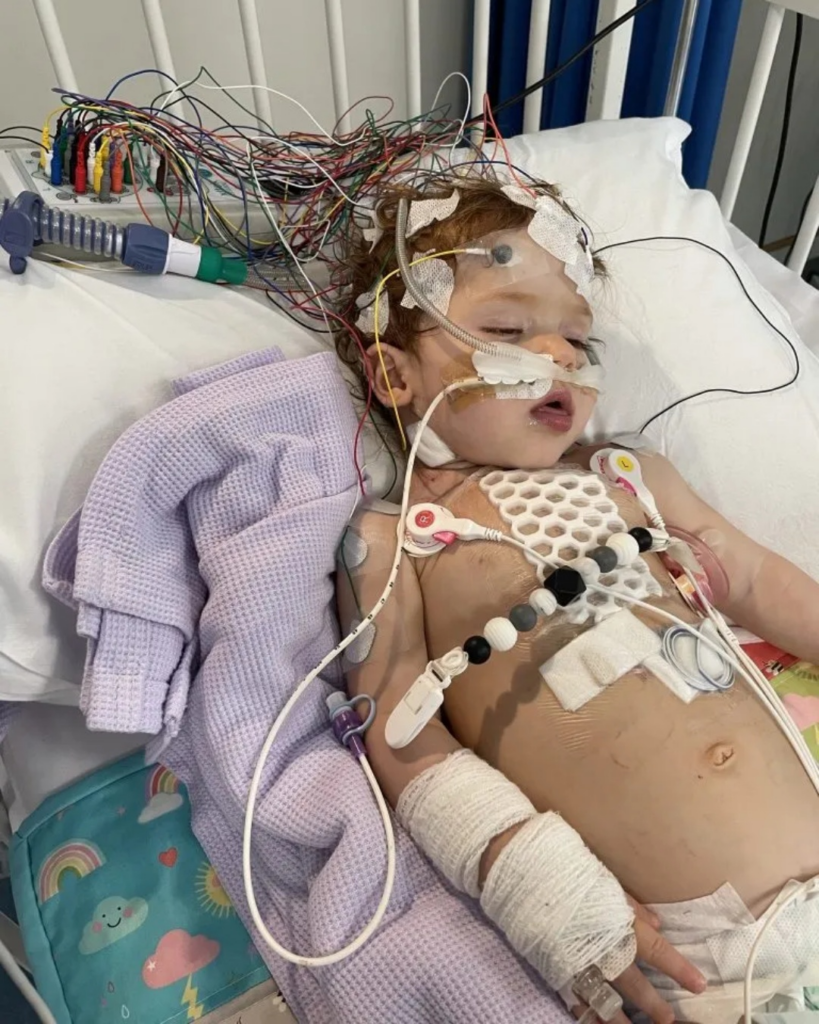
Esme entered the world in July 2020, during a time when the world itself seemed uncertain. Her mother, Hannah, experienced pregnancy under the strict conditions of a global lockdown, hoping for a smooth and uneventful journey. But from the very beginning, Esme’s life was marked by challenges that no parent can ever anticipate.
Soon after her birth, Hannah noticed that Esme struggled with feeding. Despite meticulous care and attention, she was not gaining weight as expected. Community nurses monitored her growth weekly, and over time, they delivered the worrying diagnosis:
failure to thrive. For Hannah, each day was a balance of hope and anxiety, watching her tiny daughter work tirelessly to feed, while her weight remained perilously low. Every gram gained was a small victory, but the concern always lingered: could there be a deeper, unseen cause for her daughter’s frailty?
For eleven months, Hannah and her family did everything they could to support Esme. They followed the guidance of the healthcare professionals, tried different feeding strategies, and adjusted her environment to promote growth and comfort. Yet despite all their efforts, Esme remained fragile. It was a reality that weighed heavily on her parents, filling them with an enduring sense of helplessness.

The breakthrough came unexpectedly. Esme developed a persistent cough, which prompted a visit to the doctor. The condition was diagnosed as bronchiolitis, requiring hospitalization because her oxygen levels were dangerously low. For Hannah, watching her daughter struggle to breathe was terrifying. In the hospital, Esme’s condition did not improve as expected. Days passed, and the medical team decided to perform chest X-rays. They discovered that her heart was enlarged, and a subtle heart murmur was detected during further examinations.
The next step was an echocardiogram, which revealed the truth: Esme had been born with a congenital heart defect, specifically an atrioventricular septal defect (AVSD). The diagnosis was shocking, but it also explained months of struggles. Hannah and her family now understood why Esme had faced such persistent difficulties with feeding and growth. Immediate surgery was recommended, though it had to be delayed by two weeks to allow an infection to clear.
Ten days before her first birthday, Esme underwent heart surgery. The uncertainty was immense: the surgical team could not confirm whether her valve could be repaired or if she would require a replacement. For Hannah, every hour leading up to the operation was filled with fear, worry, and a profound sense of vulnerability. Yet hope persisted, anchored in the trust they had in the medical team and the knowledge that this intervention could give Esme a future.

The surgery was successful. The valve was repaired, and doctors determined that no further intervention would be needed for many years. Post-surgery, there was concern over whether Esme would require a pacemaker. On her first birthday, the temporary wires were removed, marking a milestone: she was fully recovered and back to her energetic, vibrant self. Hannah recalls this moment vividly as a profound relief, a culmination of months of fear, uncertainty, and relentless worry.
Recovery was not immediate. Esme spent six and a half weeks in hospital, navigating the challenges of post-surgical healing. Every feeding, every attempt to play, every small smile represented progress. Hannah remembers the long nights spent by her daughter’s bedside, offering comfort, support, and love, knowing that each moment was critical for Esme’s growth and development. The hospital staff became an extended family, guiding, monitoring, and supporting both Esme and her parents through the most challenging period of their lives.
Throughout this time, Hannah often reflected on what might have been if the heart defect had been detected during pregnancy. While she is deeply grateful that the condition was discovered before it became fatal, she acknowledges that antenatal detection could have allowed for earlier planning, reduced stress, and potentially avoided months of uncertainty and hospitalization. The thought that Esme could have thrived sooner, had the defect been identified, is a lingering reflection for her family.

Today, Esme is three years old. To anyone observing her, she appears perfectly healthy. Her congenital heart disease is invisible to the outside world, yet for her parents, the memories of the fragile infant who struggled to feed are never far from mind. She thrives with energy, curiosity, and joy. Esme has embraced her “wonder line,” a subtle mark from her surgery, with pride, a visible reminder of her resilience and the life-saving care she received.
Esme’s story is not only about survival but about the impact of timely medical intervention, the power of family support, and the remarkable resilience of children. Her early struggles, followed by critical intervention, demonstrate how life-changing early detection can be, even when it occurs after birth. The journey from a fragile, failing-to-thrive infant to a thriving, energetic toddler highlights both the fragility and strength inherent in young children, and underscores the importance of awareness, vigilance, and early medical care in cases of congenital heart disease.
For Hannah and her family, every moment with Esme is precious. Her laughter, curiosity, and ability to engage fully with the world are daily reminders of the stakes they faced during her infancy. Each milestone—walking, talking, playing—is celebrated as a triumph over a life that nearly hung in the balance. Esme’s journey illustrates the profound difference that
love, medical expertise, and resilience can make in shaping a child’s future.

Her story also carries a message to the wider community: congenital heart defects can be subtle, sometimes undetected until symptoms become severe. Yet even late detection, when combined with skilled medical care, can lead to complete recovery and a healthy, fulfilling life. Awareness and vigilance are key, and Esme’s parents hope that sharing her story will inspire other families to seek timely assessments, advocate for their children, and recognize the importance of early diagnosis whenever possible.

In every smile, every step, and every burst of energy, Esme embodies hope and courage. Her journey demonstrates the profound human and medical efforts that saved her life and the resilience of a child who overcame tremendous early challenges. It is a story of triumph, love, and the remarkable difference that awareness, care, and timely intervention can make.
Esme reminds us that while the beginning may be fraught with difficulty, with care, perseverance, and the right medical guidance, children can overcome even the most daunting obstacles and thrive. She is not just surviving; she is living fully, joyfully, and healthily—a true testament to the power of early detection, love, and resilience.
A Mother’s Love in the Savannah: How One Elephant Refused to Leave Her Dying Calf.1369

In the vast, golden expanse of the savannah, life is a constant struggle—against the sun, the elements, and the ever-present dangers that stalk the plains. But on one fateful day, a story unfolded that reminded every observer of the power, resilience, and unwavering devotion of a mother’s love.
A mother elephant stood over her calf, eyes wide with panic and hope, trunk gently brushing against his small, trembling body. The calf had been poisoned by poachers, a cruel, senseless act meant to profit from ivory, leaving the young life weak, barely able to breathe, and unable to move. The world around them seemed indifferent—the grass swaying in the wind, the distant calls of other elephants echoing through the plains—but she refused to abandon him.
Hours stretched on like days. The mother elephant would nudge him with her trunk, gently lifting him, encouraging the tiniest movements. She would call out with soft rumbles, each sound a plea for survival. Every rustle in the grass, every predator in the distance, was met with a defensive sway, a warning posture. She chased away hyenas and lions with the same determination she had always used to protect her herd. The calf’s life hung by a fragile thread, but she remained vigilant, patient, and unyielding.

No one else seemed to believe a miracle was possible. To the human observers—conservationists who had been tracking the pair—hope was fading. The poison had been potent, and each breath the calf drew seemed shallower than the last. Yet the mother did not waver. She stayed, steadfast, her own body a barrier between her child and the world. She would lean against him, pressing with her enormous frame, a constant reminder that he was not alone, that he was loved, and that he was worth every ounce of effort she could give.
And then, a small but powerful sign. The calf twitched. A movement so slight it could have been mistaken for a dream. Then another twitch. Then a breath, drawn shallow but intentional, breaking the stillness that had seemed unbreakable. The mother’s eyes brightened, her trunk nudging him gently, encouraging the next motion. Slowly, the calf pushed, struggling to rise. Hours of patience, devotion, and unyielding presence culminated in this fragile spark of life.

The mother leaned beside him, lifting him with the full weight of her body, sharing strength in a way only a parent can. Inch by inch, she guided him, pressing gently with her legs, supporting with her bulk, until he finally found his feet. A wobble, a tremor—but he stood. He breathed. He survived. And then, the mother’s trumpet rang out across the plains. But this was not a warning call. It was a song of joy, relief, and triumph.
She didn’t leave when he was dying. She walked only when he could walk too. Every step they took afterward was a testament to a bond that transcends words. Every movement, every gentle touch, every protective stance was a reminder that a mother does more than protect; she gives, she sacrifices, she endures, she believes even when the world has given up.

For conservationists and onlookers who witnessed the scene, it was a lesson in devotion, patience, and the raw, transformative power of love. It was proof that survival is not only about strength or resilience—it is about presence, persistence, and the refusal to abandon someone, even when all hope seems lost.
This mother elephant’s devotion ensured that her calf would live, but her story carries a universal message. Across species, across borders, across every kind of life, a mother’s love is unwavering. It is fierce, selfless, and enduring. It is the strength that lifts the weak, the courage that defies despair, and the hope that restores life where none seemed possible.
On the savannah, under the endless sky, the calf now walks beside his mother. He is stronger, guided by her example, and marked by the love that refused to let him go. And she, majestic and steadfast, continues to roam—not just as a protector, but as a symbol of devotion that knows no bounds.
Because a mother does more than protect. She gives life again.