The Weight of Memory: Why Somali Activists are Demanding Reparations for ICE Trauma
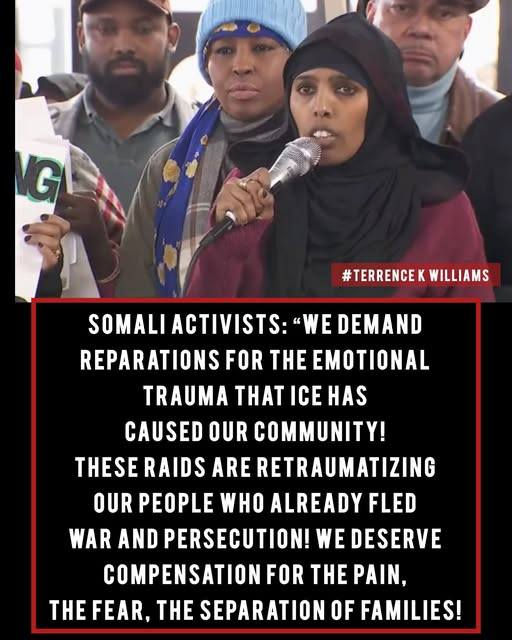
In the heart of the American Midwest, the vibrant colors of the Somali flag and the aromatic scent of sambusas in Minneapolis’s “Little Mogadishu” tell a story of resilience. But beneath the surface of this thriving diaspora lies a fractured psyche, a community grappling with a unique and recurring form of pain. Today, a new movement is rising. Somali activists in Minnesota are no longer just asking for policy changes; they are officially demanding reparations.
Their claim is centered on a profound psychological reality: the “retraumatization” caused by Immigration and Customs Enforcement (ICE) actions. For a people who fled civil war, genocide, and systemic persecution, the sudden arrival of armored agents and the forced separation of families are not merely matters of “law enforcement”—they are triggers for a dormant, deep-seated terror.
The Anatomy of Retraumatization
To understand the demand for reparations, one must first understand the history of the Somali community. The vast majority of Somali Minnesotans arrived in the United States as refugees. They left behind a country torn apart by a decades-long conflict that claimed hundreds of thousands of lives. Many witnessed the destruction of their homes, the loss of their loved ones, and the collapse of the institutions meant to protect them.
When they arrived in the U.S., they sought the “American Dream,” defined primarily by safety and stability. However, activists argue that for the past two decades, that dream has been undermined by aggressive immigration profiling.
“When a black van pulls up at 5:00 a.m. and men in tactical gear break down a door, it doesn’t matter that the jacket says ‘ICE’ and not the name of a local militia,” says one local organizer. “To the survivor of a war zone, the adrenaline, the fear, and the feeling of helplessness are exactly the same. The U.S. government promised us sanctuary, but instead, it has exported the very fear we ran away from.”
Beyond Policy: The Case for Reparations
The demand for reparations is a significant escalation from traditional advocacy. While activists have long called for an end to deportations, the shift toward “compensation for emotional trauma” acknowledges that the damage done is not just legal—it is biological and generational.
The activists’ manifesto is built on three pillars of restorative justice:
1. Financial Compensation for Pain and Suffering The argument for direct financial support is based on the economic devastation caused by ICE raids. When a breadwinner is detained or deported, the family often falls into a cycle of poverty, losing their housing and stability. Furthermore, the cost of legal fees and the loss of wages during detention create a debt trap. Activists argue that the government should provide a “settlement” to families who have been broken by these targeted actions, acknowledging the state-sanctioned role in their hardship.
2. Dedicated Mental Health Resources Trauma is not something that simply goes away; it changes the architecture of the brain. Somali activists highlight that the specific trauma of being “profiled” leads to chronic anxiety, PTSD, and a breakdown of trust within the community. Standard mental health services often lack the cultural competency or the linguistic capacity to treat Somali refugees. The demand for reparations includes the funding of community-led, culturally specific healing centers that address the intersection of war-related PTSD and ICE-related trauma.
3. An Immediate End to Targeted Profiling Reparations are not just about paying for the past; they are about securing the future. Activists demand an official acknowledgment from the government that Somali Minnesotans have been disproportionately targeted. They argue that “justice without change is just a bribe.” Acknowledgment of harm is the first step toward a new social contract between the community and the state.
The Moral and Legal Precedent
Critics often argue that reparations are a radical or unfeasible concept. However, Somali activists point to several precedents. They cite the reparations paid to Japanese Americans interred during World War II and the settlements reached in cases of police misconduct.
“If a corporation causes environmental trauma to a neighborhood, they pay for the cleanup and the healthcare of the residents,” an activist leader stated during a recent rally. “ICE has caused a ‘human-made disaster’ in our neighborhoods. Why is our trauma less worthy of a settlement?”
The movement also leans on the concept of Transitional Justice—a framework often used in post-conflict nations to address systemic human rights abuses. By applying this framework to the U.S. immigration system, Somali activists are reframing the debate: they are no longer “immigrants asking for a favor,” but “survivors of state harm demanding their rights.”
The Silence of the Suffering
One of the most heart-wrenching aspects of this movement is the stories of the children. In Minnesota, thousands of Somali-American children grow up as U.S. citizens, yet they live with the constant shadow of “the knock at the door.”
Psychologists working within the community have noted a phenomenon of “vicarious trauma,” where children who have never seen a war zone exhibit the same symptoms of hyper-vigilance and fear as their refugee parents. This “separation of families” mentioned in the activists’ demands is not just a physical distance; it is a psychological fracturing of the family unit. The government’s actions have created a generation of children who view their own country’s enforcement agencies as an existential threat.
The Global Context of the Somali Diaspora
Minnesota is home to the largest Somali population outside of East Africa. Because of this, what happens in Minneapolis reverberates globally. The demand for reparations is being watched by Somali communities in the UK, Canada, and Scandinavia.
By standing up in Minnesota, these activists are challenging the global narrative of the “grateful refugee.” They are asserting that being a refugee does not mean forfeiting one’s right to dignity or mental health. It is a bold reclamation of agency. They are saying: “We are here, we are citizens, and we refuse to suffer in silence while our community is retraumatized for the sake of political optics.”
Conclusion: A Call for Acknowledgment
The path forward is fraught with political and legal challenges. Reparations are a “third-rail” issue in American politics, often met with fierce resistance. However, the Somali activists in Minnesota are undeterred. For them, the victory is already partially won in the very act of demanding.
By naming their pain as “ICE Trauma” and labeling the remedy as “Reparations,” they have changed the language of the struggle. They have moved the conversation from the courtroom to the clinic, and from the border to the heart.
As the movement grows, the message to the government is clear: The cost of these policies cannot be measured solely in deportation numbers or budget lines. It must be measured in the sleepless nights of mothers, the terrified tears of children, and the broken trust of a community that only ever wanted to feel safe.
“No more silence! No more suffering without justice!” is not just a chant—it is a promise of a community that has survived the worst of humanity and is now demanding the best of American justice.
#ReparationsForSomaliMN #JusticeNow #EndTheProfiling #HumanRights #MinnesotaVoices #ICETrauma #SpeakUp #SomaliActivists