📍 WASHINGTON, D.C. — In a landmark ruling that shook the nation’s political and economic landscape, the U.S. Supreme Court on Friday struck down former President Donald Trump’s sweeping global tariffs, finding that he exceeded his constitutional authority by imposing tariffs without clear approval from Congress.
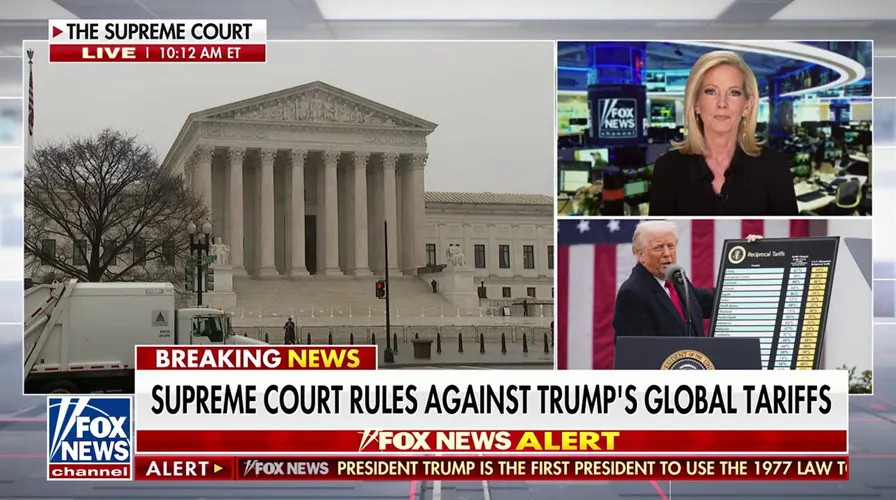
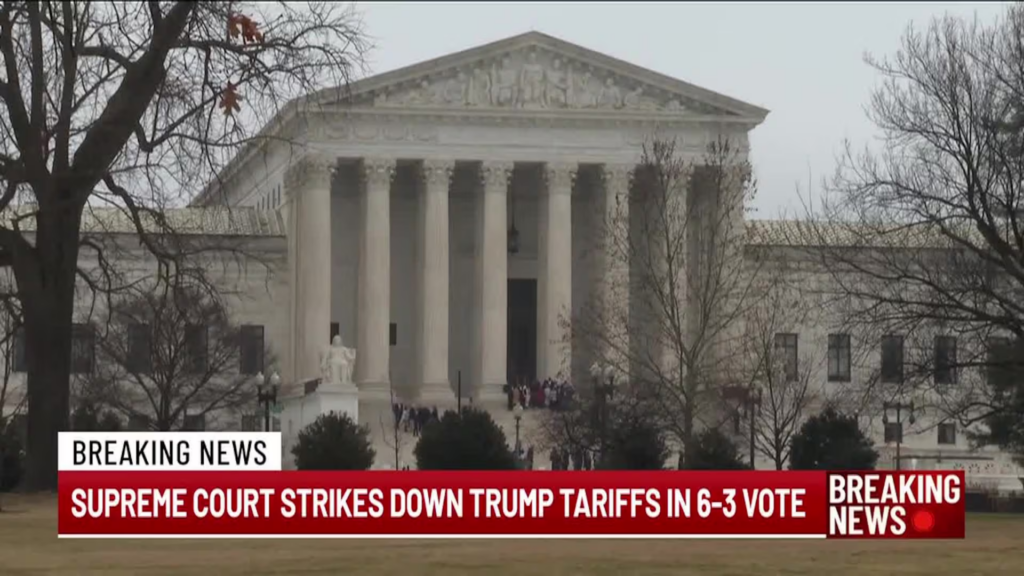
The 6–3 decision, authored by Chief Justice John Roberts, held that the International Emergency Economic Powers Act (IEEPA) — the statute Trump had invoked — does not grant the president unilateral authority to levy broad tariffs on imports. The ruling reaffirmed the constitutional principle that Congress holds the power to impose taxes and tariffs, a cornerstone of U.S. legislative authority.
“Only Congress has the constitutional power to impose tariffs,” Roberts wrote in the majority opinion. “The Framers did not vest any part of the taxing power in the Executive Branch.”
Republican-appointed justices Neil Gorsuch and Amy Coney Barrett joined the majority, highlighting the court’s unusual bipartisan rebuke of executive overreach.
Trump Responds with New Tariff Plan
Despite the setback, President Trump quickly announced a new tariff strategy. On social media and in public remarks, he declared that he would raise a global tariff rate from 10% to 15% on all imports, invoking a different legal authority under Section 122 of the Trade Act of 1974 — a rarely used provision that permits temporary tariffs for up to 150 days without full congressional approval.
Trump called the Supreme Court decision “deeply disappointing” and criticized the justices, including some he himself appointed, for weakening U.S. trade policy. He vowed to pursue every available legal avenue to protect American industries and reduce trade imbalances.
Economic and Political Fallout
The ruling has immediate implications for the U.S. economy. Financial markets reacted sharply, with stocks and commodity prices adjusting to the news that Trump’s original tariff regime — which had collected more than $133 billion in duties — may be unwound or refunded.
Domestic political leaders from both parties weighed in. Democrats welcomed the decision as a defense of constitutional checks and balances, while some Republican lawmakers expressed concern that limiting executive power could weaken America’s negotiating hand in foreign trade relations.
Internationally, foreign governments and trading partners praised the ruling, suggesting it could ease economic tensions caused by the Trump-era tariff policies, though they also cautioned about the uncertainty surrounding America’s next steps.
Looking Ahead
The dispute over tariff authority marks one of the most significant challenges to presidential economic power in decades. With midterm elections approaching and global markets watching closely, the balance between executive ambition and statutory authority remains at the forefront of U.S. political debate.