
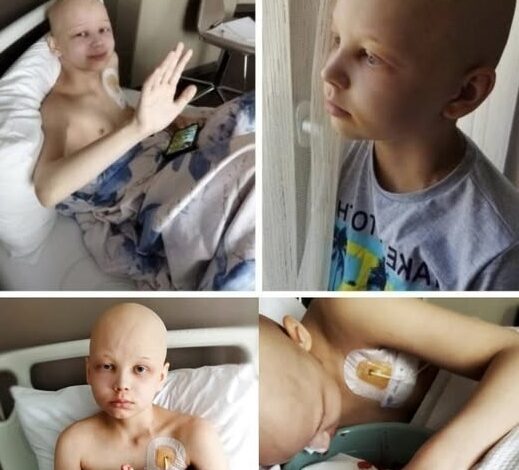
A Mother’s Promise: Maksym’s Fight for Life
The moment the word cancer left the doctor’s lips, time stopped.
I remember the sound of my own heartbeat pounding in my ears, the room spinning as if the world itself had cracked open beneath my feet. Tears streamed down my face before I even understood what was happening. All I could think was this: I need to take my son and run. I need to protect him. I need to make this disappear.

But you cannot run from cancer.
My son Maksym—my little boy, my only child—was suddenly fighting a disease no child should ever face. In that instant, life lost all meaning. The future I had imagined for him vanished. Birthdays, school days, laughter, dreams—everything felt fragile, like glass about to shatter.
Maksym was always full of life. He laughed easily, loved to play, and filled our home with warmth. That is why the first signs didn’t alarm me. It began with a slight pain in his legs, a weakness that appeared mostly at night. Like any mother, I assumed it was nothing serious—perhaps he had fallen while playing, perhaps growing pains. Children are always running, jumping, falling.

Still, something felt wrong.
I took him to the hospital, searching for reassurance. The doctor examined him and told us he was fine. We went home, trying to believe those words. But the pain did not disappear. It returned stronger, deeper, more persistent. Maksym cried at night. I lay awake beside him, listening to his breathing, my heart filled with fear I couldn’t explain.
I knew we had to try again.

We went to another hospital in Kyiv. More tests. More waiting. More silence. When the doctors finally spoke, their faces told me everything before their words did. I walked out into the hallway, saw my son sitting there waiting for me, and collapsed into tears.
They said he had a tumor.
The days that followed were unbearable. We waited for biopsy results, clinging to the fragile hope that there had been a mistake. That hope died on October 21, 2018.
Maksym was diagnosed with stage IV Ewing’s sarcoma. The cancer had already spread. Metastases were found in the sacrum of his spine. The tumor was inoperable. Doctors told us the truth no parent wants to hear: in Ukraine, they could only offer treatment to prolong his life—not save it.
I felt like my heart had been torn out of my chest.
Still, I refused to give up.
Maksym endured 15 rounds of chemotherapy and 30 sessions of radiotherapy. His small body suffered through pain, nausea, weakness, and exhaustion. Each hospital visit felt like walking into a battlefield. I watched my child grow thinner, quieter, weaker—and yet, he kept fighting.
I held his hand during treatments. I smiled when he smiled. I cried when he slept.
But despite everything, the tumor continued to grow.

That was the moment I knew we had to leave our country to save him. I searched endlessly for clinics abroad, reading stories, sending messages, begging for help. Finally, we received an answer from the Memorial Clinic in Turkey. They agreed to treat Maksym. For the first time in years, I felt something I hadn’t felt in a long time. Hope. The cost, however, was overwhelming—far beyond anything we could afford. And then something extraordinary happened. People we had never met opened their hearts. Strangers donated. They shared our story. They believed in my son.
Because of them, Maksym is alive today.
On July 15, 2021, he began a new treatment plan in Turkey: 12 cycles of chemotherapy followed by a stem cell transplant. This treatment was our last and best chance.
The journey has been incredibly hard.
After each cycle, Maksym’s condition worsens. His immune system collapses. Infections appear. Unexpected complications force long hospital stays. Sometimes he is too weak to stand. Sometimes he cries quietly, trying not to scare me.
But even in his pain, he is brave.

He smiles at the nurses. He jokes when he can. He tells me he will be okay—as if he is the one comforting me. His strength is something I cannot put into words. He fights not just for himself, but for our future together.
Today, doctors say the words I once thought I would never hear: the cancer is almost gone.
Almost.
There is still a small part remaining. To eliminate it completely and prevent relapse, Maksym must finish two final chemotherapy cycles and the stem cell transplant. These final steps are critical. Without them, everything we have fought for could be lost.
But the costs have increased. Unexpected hospitalizations, complications, and medications have drained every resource we had. A new bill has arrived, and I am terrified.
We cannot continue alone.
Stopping now would mean risking my son’s life when we are so close to saving it. As a mother, I cannot accept that. I will not accept that.

Maksym is not just a patient. He is a child who loves life. He deserves a future without hospital walls, without needles, without fear. He deserves to grow, to laugh, to dream, to live.
I am asking—begging—for help.
Every donation matters.
Every share matters.
Every prayer matters.
Your kindness gives my son more than treatment—it gives him a chance to live. A chance to grow up. A chance to leave cancer behind forever.
We are racing against time. But together, we can win this fight.
Please help us save my son.
They Made Fun of His Scar… Not Knowing It Saved His Life
When Leo Hutchinson entered the world, he appeared healthy and perfect in every way. Like most newborns, he slept peacefully, curled into his parents’ arms, unaware that beneath his soft skin, something was already terribly wrong.
Hidden from view, the bones of Leo’s skull were fusing together far too early. As his brain began to grow—as every baby’s does—it had nowhere to expand. Week by week, pressure built inside his head, silently threatening his development, his eyesight, and his life itself.

Doctors soon delivered a diagnosis no parent is ever prepared to hear: sagittal craniosynostosis. It is a rare and dangerous congenital condition in which one or more seams of the skull close prematurely. Without urgent intervention, Leo faced a future of severe brain damage, permanent blindness, seizures—or death.
For Leo’s parents, the news was devastating. Their baby had only just begun life, yet every passing day without surgery brought him closer to irreversible harm. There was no choice, no alternative. Surgery was the only chance to save their son.
At just seven months old, Leo was taken into the operating theatre at Birmingham Children’s Hospital. His tiny body lay surrounded by machines and wires, his future resting entirely in the hands of surgeons. His parents kissed him goodbye, trying to stay strong as doors closed behind him.
What followed were nine excruciating hours of waiting.
Time seemed to stop. Every minute felt heavy with fear. Every thought carried the same terrifying question: Would their baby survive?

Inside the operating room, surgeons carefully cut, separated, and reconstructed Leo’s skull, reshaping it piece by piece to create space for his growing brain. The procedure was delicate, complex, and filled with risk—but it was also nothing short of miraculous.
When the surgery finally ended, Leo was alive.
His life had been saved.
But survival came with a visible reminder—a long scar stretching from ear to ear across his head. It was bold, unmistakable, impossible to ignore. For anyone unfamiliar with his story, it might have looked shocking. For Leo’s family, it was a symbol of hope, sacrifice, and second chances.
As Leo grew, something remarkable happened.
He didn’t hide his scar.
He didn’t feel ashamed of it.
He wore his hair short and faced the world with confidence.
Leo grew into a bright, joyful child who loved football, toy cars, and making people laugh. He was curious, energetic, and full of life. The scar that once terrified his parents became simply a part of who he was—a quiet badge of survival worn without fear.
But Leo’s journey was not over.
At just two years old, doctors discovered swelling near his optic nerve. Once again, his eyesight—and his future—were at risk. Leo underwent a second operation, during which surgeons placed screws in his skull to relieve the pressure and protect his vision.

For a child so young, it was another battle no one should have to face.
Yet Leo endured.
He continued to grow, play, and smile, carrying a strength far beyond his years. His scars never defined him. If anything, they reflected the resilience that lived inside him.
This year marked an important milestone. Leo was preparing to start school—a moment filled with excitement, nerves, and pride. Like many children, he wanted to feel confident. He wanted to look smart. A simple haircut felt like a big step.
So his dad took him to a barbershop in Cardiff. It was meant to be an ordinary, happy moment—a father and son, sharing laughter and anticipation.
But outside that barbershop, everything changed.
A group of teenagers walked past. They noticed Leo’s haircut. Then they noticed the scars on his head. And instead of empathy, they chose cruelty.
They laughed.
They mocked.
They made comments without understanding what they were looking at.
In a matter of seconds, words spoken without thought shattered something precious.
For the first time in his life, Leo felt embarrassed by his scars. The same scars he had once worn with pride suddenly felt like something to hide. He pulled his hoodie up over his head and kept it there for the rest of the day, shrinking away from the world.
When Leo’s mother, Georgia Hutchinson, heard what had happened, her heart broke.
Her son—who had faced surgeries, hospitals, and life-threatening odds—had been undone not by pain, but by cruelty. Years of quiet confidence were shaken by strangers who never stopped to think.
“It broke his little heart,” Georgia said.
Those teenagers didn’t know Leo’s story.
They didn’t know about the sleepless nights in hospital.
They didn’t know about the nine-hour surgery.
They didn’t know that doctors once warned his parents that their baby might not survive.
They didn’t know that without those scars, Leo wouldn’t be alive.
According to the charity Headlines, craniosynostosis affects around one in every 2,000 babies in the UK. Thousands of children grow up carrying scars that tell stories of survival—stories written long before they could speak.
These scars are not signs of weakness.
They are evidence of courage.
They are proof that medicine, love, and determination can rewrite fate.

Leo did not choose his condition.
He did not choose surgery.
He did not choose scars.
But every single day, he chooses bravery simply by being himself.
Cruel words may have shaken his confidence for a moment, but they do not define his future. Leo’s scar is not something to hide—it is a reminder that he fought for his life before most children take their first breath.
It is the mark of a battle survived.
A life saved.
A story that deserves to be told.
Because what some people laughed at…
is the very reason Leo is alive today.
Two Hearts, One Miracle: The Extraordinary Journey of Anna Grace and Hope Elizabeth
Anna Grace and Hope Elizabeth Richards came into this world already facing challenges most people will never encounter in a lifetime. From their very first breath, their lives were intertwined in the most literal and fragile way possible. Born conjoined at the abdomen and sharing vital organs — including a complex and life-threatening heart connection — their survival was uncertain from the moment doctors confirmed their condition.

Their parents were thrust into a reality they had never imagined. Instead of planning for ordinary newborn milestones, they were forced to confront medical terminology, surgical risks, and life-or-death decisions. Each appointment brought new questions, new fears, and an overwhelming sense of responsibility. Yet, even in the face of uncertainty, one thing remained unshaken: their determination to fight for their daughters.
Born at 37 weeks, Anna Grace and Hope Elizabeth entered the world surrounded by specialists, monitors, and cautious optimism. Their condition, an extremely rare form of conjoined twinning, meant that their hearts were intricately connected in a way that prevented them from surviving independently. Every heartbeat was shared. Every breath depended on careful balance. What most people take for granted — circulation, movement, rest — required constant medical supervision.

The early days were filled with anxiety and vigilance. Their parents learned quickly that there were no guarantees. Each day was a gift. Each stable moment was a victory. And yet, despite the complexity of their condition, the girls showed remarkable resilience. They grew. They responded. They held on.

For nearly two years, life revolved around hospital visits, tests, and careful monitoring. Their parents lived in a constant state of cautious hope, celebrating small milestones while knowing that the path ahead was uncertain. The girls’ shared heart made even routine illnesses dangerous. Infections were feared. Simple setbacks could quickly become life-threatening. But still, Anna Grace and Hope Elizabeth continued to surprise everyone around them.

Throughout it all, their parents never stopped believing in a future where their daughters could live independent lives. That hope led them to the most difficult decision of all — separation surgery. The procedure was extraordinarily complex. It required months of planning, advanced imaging, and collaboration between highly specialized surgeons, cardiologists, anesthesiologists, and nurses. The risks were immense. There was no absolute certainty that both girls would survive. The possibility of loss loomed heavily over every discussion.

Yet their parents chose courage. At nearly two years old, Anna Grace and Hope Elizabeth were wheeled into surgery — two lives bound together, facing the unknown. The operation lasted for hours, with teams working in perfect coordination, carefully separating shared structures and reconstructing what nature had joined. When the surgery was finally complete, something extraordinary had happened. Both girls survived. For the first time in their lives, Anna Grace and Hope Elizabeth existed as two separate individuals.

But the journey did not end there. Recovery brought its own set of challenges. Their bodies had to adjust to independent circulation and function. Physical therapy became essential. The risk of infection remained high. There were moments of uncertainty, setbacks that tested everyone’s endurance, and days when progress felt painfully slow. Still, the girls persisted. With each passing week, they grew stronger. They adapted. They learned what it meant to move, rest, and exist on their own. Slowly, their personalities began to emerge — subtle differences that reminded everyone they were no longer one, but two. Today, Anna Grace and Hope Elizabeth are thriving. They are continuing to heal, grow, and discover the world as individuals. Their parents watch them with awe and gratitude, fully aware of how close they once came to a very different outcome. Every smile, every laugh, every moment of independence is a reminder of just how far they have come.

Their story is not just about medical achievement. It is about love that refuses to give up. About parents who chose hope when fear would have been easier. About resilience in the smallest bodies. And about miracles that happen when skill, faith, and determination come together. Anna Grace and Hope Elizabeth’s journey stands as a powerful testament to what is possible, even when the odds seem insurmountable. Though their road ahead may still hold challenges, they have already proven something extraordinary — that life, when fought for with love and courage, can overcome even the most impossible beginnings.
Their story continues, not defined by what they were born with, but by the strength they carry forward every day.
A Miracle of Strength: Jayce’s Fight for Life
Bailey’s pregnancy had been calm and uneventful — the kind every expecting mother hopes for. Each appointment brought reassurance, each week felt like a quiet step closer to meeting her baby. Nothing suggested that everything was about to change.
At 24 weeks, Bailey noticed something that immediately unsettled her. What looked like a mucus plug appeared far too early. Hoping it was nothing, she went in for an ultrasound the next day. Instead of reassurance, she was met with devastating news: her cervix was nearly nonexistent and already funneling. Just weeks earlier, it had been long and closed. The sudden change was shocking, frightening, and completely unexpected.

Within hours, Bailey was transferred to a hospital far from home. Doctors moved quickly, administering steroid injections to help Jayce’s lungs develop and placing her on strict hospital bed rest. Progesterone was added in hopes of slowing what seemed inevitable. From that moment on, every day became a waiting game — measured not in weeks, but in hours gained.
For nearly a month, Bailey lived inside hospital walls. She watched the world move on outside while she stayed still, clinging to hope. Isolation, fear, and exhaustion weighed heavily, but her focus never wavered. Every extra day her body held on felt like a small miracle for Jayce.
Eventually, she was allowed to go home — but the relief was short-lived. Just three days later, cramping sent her rushing back to the hospital. At 29 weeks, Bailey was readmitted and told she was already dilated, with membranes bulging. The odds of stopping labor were slim.

Six hours later, Jayce was born.
Weighing just 3 pounds, Jayce entered the world far earlier than planned — but stronger than anyone expected. Despite his size, he began breathing on his own, surprising doctors and filling the room with cautious hope. Though he needed support and time to grow, he avoided many of the severe complications often faced by premature babies.
The NICU became Jayce’s first home — a place filled with monitors, soft alarms, and tireless nurses. His days were marked by small victories: steady breathing, weight gain, stronger feeds. Bailey and her family learned to celebrate progress that others might overlook, finding joy in every step forward.
Slowly, Jayce grew. He proved again and again that he was a fighter.
After weeks of care, the moment finally came — Jayce was strong enough to go home. What once felt impossible became reality. Today, he is a happy, healthy little boy, full of life and curiosity, a living reminder of resilience and hope.

Looking back, Bailey is filled with gratitude — for the doctors, nurses, and medical staff who carried them through their darkest moments, and for the strength she discovered within herself. Jayce’s journey isn’t over, but his story already stands as proof that even the smallest fighters can overcome overwhelming odds.

