
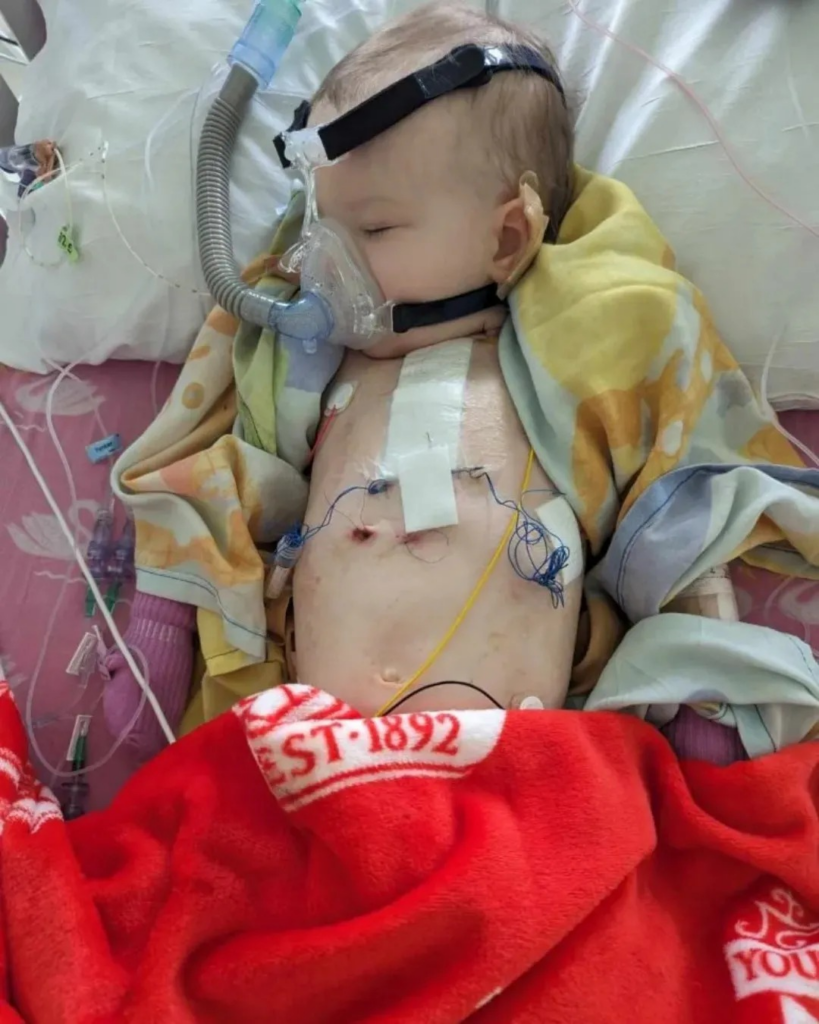
At Jenny’s 20-week scan, excitement quickly shifted into fear when the sonographer paused, studied the screen more closely, and gently explained that something didn’t look right with the baby’s heart. Jenny was referred to a larger hospital for more detailed testing — a week filled with worry, questions, and the constant hope that everything would turn out to be nothing serious.

But the following week, doctors confirmed what no parent ever wants to hear:
Eva had pulmonary atresia with VSD and major aortopulmonary collateral arteries (MAPCAs).
It was a frightening diagnosis. Yet in the middle of the shock, one thing brought comfort: the defect was discovered
early. That early detection meant time — time to understand, time to plan, and time to prepare for the journey ahead.
Jenny and her family spent countless hours reading through stories on the Tiny Tickers Facebook page, finding encouragement from other parents who had walked similar paths. Those shared experiences became a lifeline, offering hope and practical wisdom as they braced themselves for Eva’s arrival.
And then, something miraculous happened.
Eva was born far healthier than anyone expected.
Her strength surprised everyone — including her medical team — and that small blessing made the early days just a little easier to bear.
Eva spent nearly a month in a specialist children’s hospital, under the close watch of cardiologists as they evaluated options and monitored her condition. Each day was filled with uncertainty, yet Eva continued to do well, and eventually, the doctors gave the family the news they’d been longing for:
Eva could go home.
The next year was a precious gift — a full year of home life, milestones, new routines, and regular check-ups to keep track of Eva’s heart. But everyone knew that surgery would eventually be necessary.
When the time finally came for her first open-heart operation, Jenny and her family felt a swirl of emotions: fear, hope, anxiety, and determination all at once. They trusted the team caring for Eva, but nothing prepares a parent for the moment they hand their child over to surgery.
And then, another setback — the first operation didn’t go to plan.
Eva needed a second open-heart surgery just days later.
The two weeks that followed were the hardest of all. Eva struggled, and Jenny watched helplessly as her little girl battled through complications, relying on ECMO support and invasive ventilation to stay stable.
But Eva’s spirit proved stronger than the storm.
Little by little, she improved.
Step by step, she began to recover.
And now, in their third week at the hospital, Jenny can finally breathe again.

Eva is off ECMO.
Off the invasive ventilator.
And doing amazingly well.
It has been a journey marked by fear, resilience, and countless prayers — but also by profound gratitude.
Jenny will forever be thankful for the sonographer who noticed the first sign of trouble, the specialists who guided them, and the extraordinary medical staff who have supported Eva every step of the way.
Eva’s story is still being written.
But already, she has shown one truth with absolute clarity:
Early detection saved her life — and her courage is lighting the way forward.
River the Cat: Oakley’s Guardian and Masseuse 2375

There are moments in life that remind us how love does not always come in the form we expect, how it transcends boundaries, species, and convention. Oakley, a senior dog with a heart as big as his spirit, had always been the shining light in his family’s home. Adopted at around two years old in 2015, Oakley quickly became inseparable from his humans, embracing adventures, cuddles, and the simple joys of being part of a loving household. He had a playful energy, a calm reassurance, and a loyalty that made him beloved by everyone who knew him. But life, as it often does, introduced challenges. When a tiny, fragile kitten named River arrived as a medical foster, recovering from hip surgery, Oakley’s world changed in subtle and profound ways. The kitten was timid, injured, and in need of protection. Oakley, with his gentle demeanor, offered it without question, becoming River’s anchor as the little cat began to navigate the complexities of human care and the uncertainty of a new home.

The bond formed between Oakley and River was immediate and extraordinary. River gravitated toward Oakley, sensing a spirit who would not only protect him but understand him in ways that only another creature could. Oakley became River’s teacher, friend, and comfort, and River flourished under Oakley’s watchful eyes. By the time River had fully recovered from his surgery, his place in the family was secure, and adoption became permanent. River had grown close not only to Oakley but to the entire family, embracing humans and animals alike, yet his connection to Oakley was singular, special, and unshakable. It was as if River recognized Oakley’s role in his survival and chose to honor it with a devotion that would only deepen over time.
Years passed, and the once young, spry dog began to show signs of age. Oakley’s back legs grew weaker, mobility became a challenge, and then an iliopsoas injury made daily movement even more painful. Physical therapy and massage became essential for Oakley’s comfort and quality of life. His human family provided what they could, delivering massages that eased tension and soreness, but Oakley soon discovered a source of comfort he had not anticipated: River. The little cat, who had once relied on Oakley for protection, began to take on a new role. He watched intently as Oakley received his massages, absorbing each movement, each touch, and then, one day, River stepped in. With careful precision and the gentlest of paws, he began kneading Oakley’s fur, mimicking what he had observed, offering warmth, pressure, and reassurance. It was a simple act, yet one that carried layers of love, empathy, and instinctive caregiving.
River did not stop at that first instance. What began as a single moment became a ritual. Every night, River would snuggle up to Oakley, gently massaging him with paws that seemed far too small to provide so much comfort. The cat’s persistence and attentiveness were astonishing; he recognized Oakley’s needs before anyone else did, responding with patience and dedication that rivaled the most devoted human caretaker. Soon, this behavior extended beyond the confines of the nightly routine. Whenever Oakley rested, whether on the couch, on the floor, or by a window where sunlight streamed through, River would be at his side, offering kneads, gentle paw presses, and cuddles that radiated calm and reassurance. Oakley, in return, made quiet groans of pleasure, leaning into the warmth of River’s body, his eyes half-closed in contentment, clearly appreciating the comfort his feline brother provided.
The dynamics between Oakley and River evolved into something extraordinary. River had assumed the role of a caretaker, a therapist, and a companion who provided relief not just for Oakley’s physical pain, but for the emotional weight of aging. Oakley’s life, once centered on play and adventure, now included moments of vulnerability, and River was always there, steadfast and unflinching, offering care that went beyond instinct and into the realm of conscious devotion. The family observed in awe as the cat who had once needed protection became the one providing it, demonstrating that love is cyclical, responsive, and transformative. River’s commitment was unrelenting; he offered massages at any time of day, often spontaneously, simply because he sensed Oakley needed him.
This relationship between a senior dog and his cat companion speaks to a universal truth: that healing and comfort are not bound by species. River’s massages were not merely play or curiosity; they were an expression of empathy and loyalty, a way to soothe Oakley’s body while affirming his presence, his safety, and his dignity. The two animals navigated Oakley’s age-related challenges together, River intuitively understanding what was required to provide relief and Oakley responding with trust and visible appreciation. The connection between them became a cornerstone of the household, a daily reminder of how interdependent life can be, and how love manifests in the most unexpected and beautiful ways.
Oakley’s human family witnessed the profound impact of River’s care. They noticed Oakley’s relaxation during the massages, the contented sighs, and the way he leaned into River’s touch. The cat’s small, insistent movements brought comfort in a way human hands could not always replicate, blending warmth, pressure, and familiarity into a healing ritual. River’s dedication was a testament to his intelligence, emotional awareness, and capacity for empathy, highlighting a rare and remarkable bond that transcends ordinary companionship. In Oakley’s later years, as physical challenges accumulated, River became a lifeline, a source of consistent support, and a reminder that even in frailty, love could be abundant and restorative.
The story of Oakley and River is not just one of a senior dog receiving care, nor of a cat learning to show affection—it is a narrative of reciprocity, devotion, and the profound ways in which animals can impact each other’s lives. River’s instinct to nurture, born from his early dependence on Oakley, evolved into deliberate care that improved Oakley’s quality of life, offering comfort, ease, and companionship at a critical time. The two became inseparable not out of necessity alone, but out of choice, out of mutual understanding, and an unwavering bond built on years of shared experiences, recovery, and love.
As Oakley continues to navigate the challenges of aging, and River grows into the role of caretaker and comforter, their story remains a beacon of hope and inspiration. It demonstrates the capacity of animals to understand, respond, and adapt to each other’s needs. It reminds us that love is not confined to human relationships, and that caregiving can be expressed in countless forms, from a human hand to a small, kneading paw. River’s nightly massages, his spontaneous displays of affection, and his constant presence offer more than relief; they offer affirmation, trust, and a deep emotional connection that defines the essence of family, loyalty, and devotion.

Through the story of Oakley and River, we see the beauty of companionship at its finest: two beings, different in species but united in purpose, supporting one another through vulnerability, aging, and need. River’s role as Oakley’s masseuse is more than a quirky habit—it is an expression of pure, selfless care, and a reminder that love can be quiet, consistent, and transformative. Their bond is an enduring testament to the ways in which empathy, trust, and shared experience can create a lifeline, one that sustains life, brings comfort, and fills the home with warmth and reassurance. Oakley’s happiness, River’s devotion, and the family’s awe at the depth of their connection paint a portrait of companionship that is both extraordinary and profoundly human in its lessons about love, care, and the magic of being present for those who need

